

Conditional Formatting in Salesforce Using AGrid


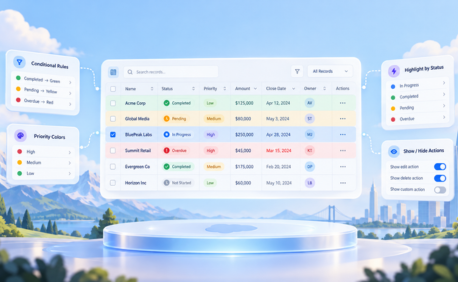
Table of Contents


The Salesforce Limitation: Echoed Across the Community
One of the most consistent requests in the Salesforce ecosystem has been the ability to apply conditional formatting directly inside list views.
Across IdeaExchange and Trailblazer Community discussions, admins ask how to:
These discussions reflect a recurring usability gap. While Salesforce has introduced conditional formatting for analytics and certain record page fields, native row-level highlighting inside standard list views and related lists remains limited.
For teams that manage data in bulk, this is where visibility matters most.
AGrid addresses this directly by bringing rule-driven AGrid Conditional Formatting in Salesforce list views and related lists.
How AGrid Resolves These Community Pain Points
AGrid brings conditional formatting directly into Salesforce list views and related lists.
Instead of formatting only individual fields on record pages, AGrid allows the grid itself to respond to business logic.
This directly answers the community requests by enabling: Whether it's highlighting overdue tasks or high-priority opportunities, admins can define how key information should stand out, ensuring it's easy to recognize and act upon.
Rather than requiring reports to interpret priority, the list view itself becomes intelligent.
Row Highlight
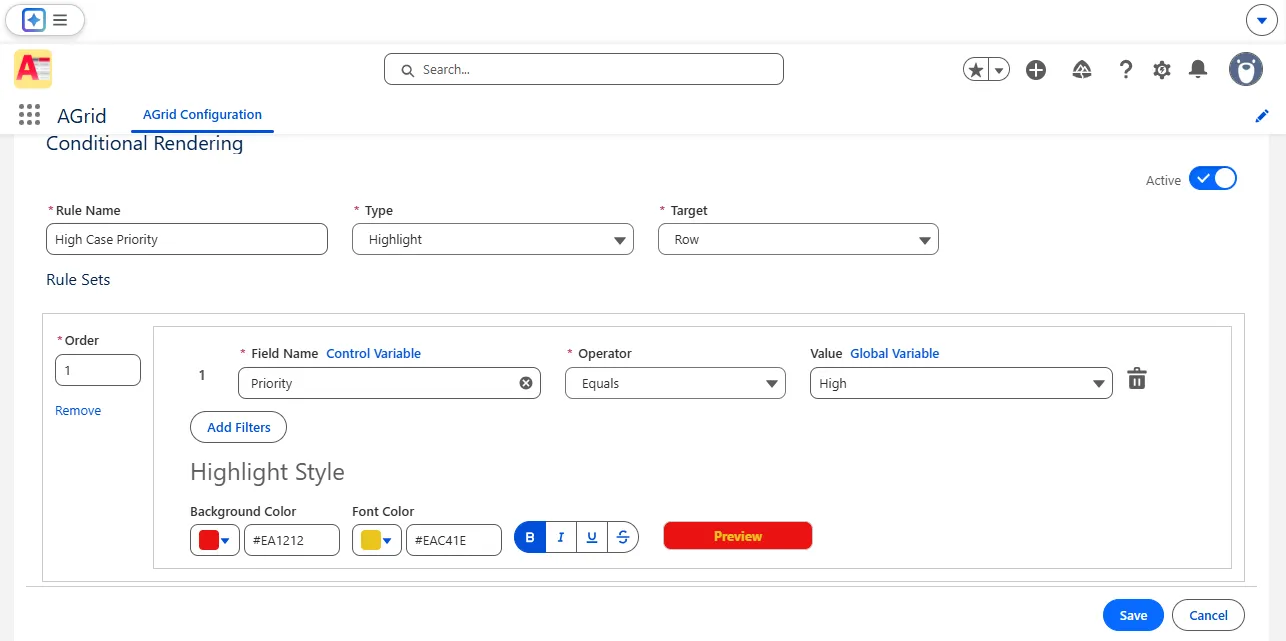
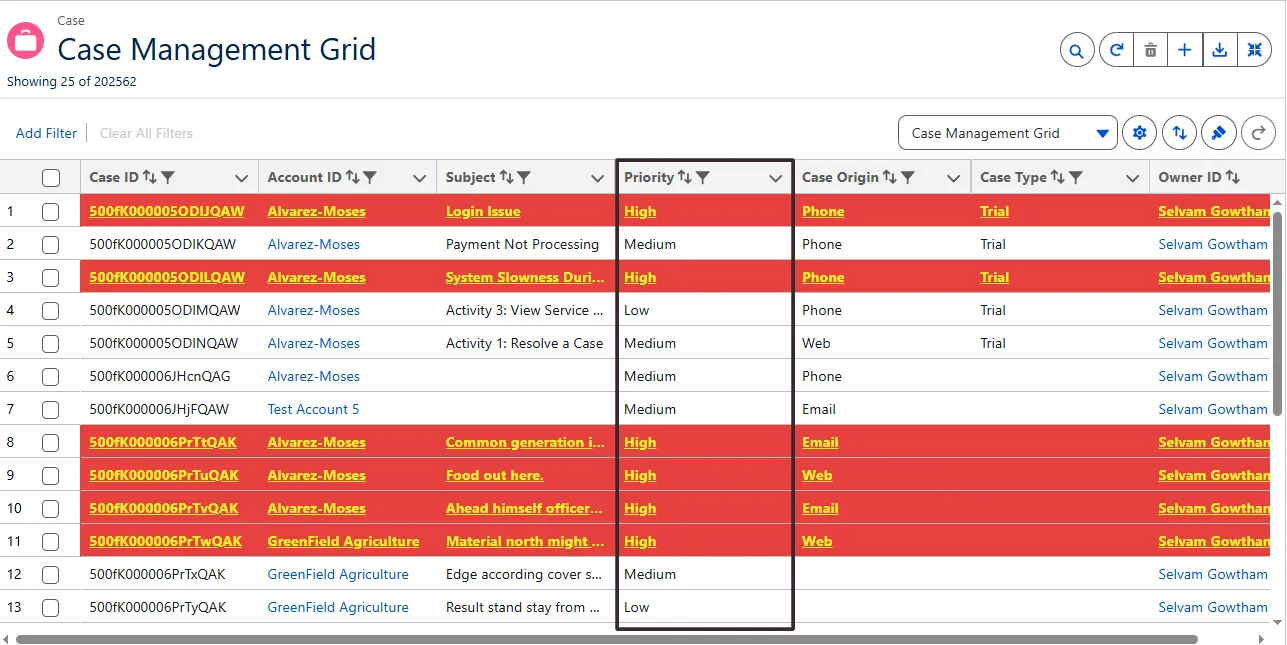
Row Highlight allows the entire record to be visually formatted (change background color or font color or text formatting styles) when defined conditions are evaluated as true.
This solves one of the most common IdeaExchange requests: highlighting records dynamically.
For example:
- Opportunities past Close Date can stand out automatically.
- High-priority Cases become immediately visible in related lists.
- Escalated records are clearly differentiated from standard records.
Row Highlight reduces scanning effort and improves Salesforce data visibility at scale.
Column Highlight
Column Highlight focuses on conditional formatting (change background color or font color or text formatting styles) on a specific field within the row.
This addresses requests for highlighting particular values without changing the entire record.
For example:
- Highlight the Amount field when it exceeds a defined threshold.
- Emphasize Case Status when equal to Escalated.
- Draw attention to approaching Close Dates.
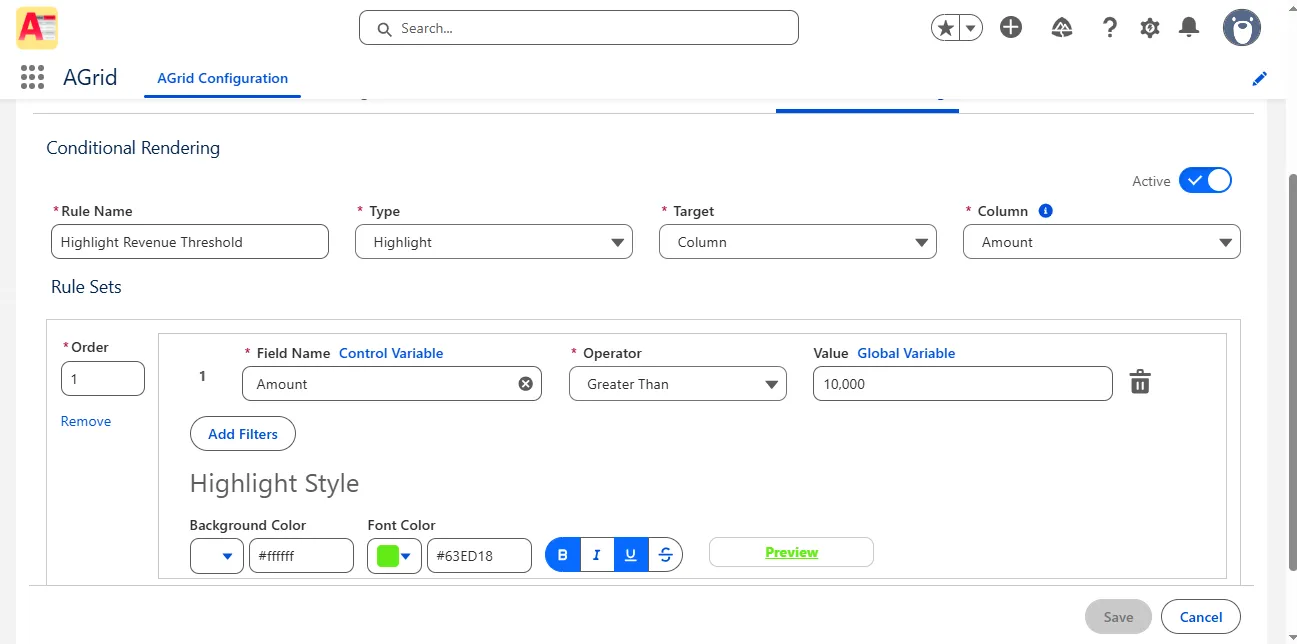

If both row and column rules apply, column-level formatting takes precedence — ensuring consistent behavior.
Conditional Action Control
Several community discussions also revolve around contextual control inside list views.
AGrid introduces Conditional Action Control, allowing row actions to respond to defined logic.
Based on conditions:
- Actions can be hidden entirely.
- Actions can remain visible but be disabled.
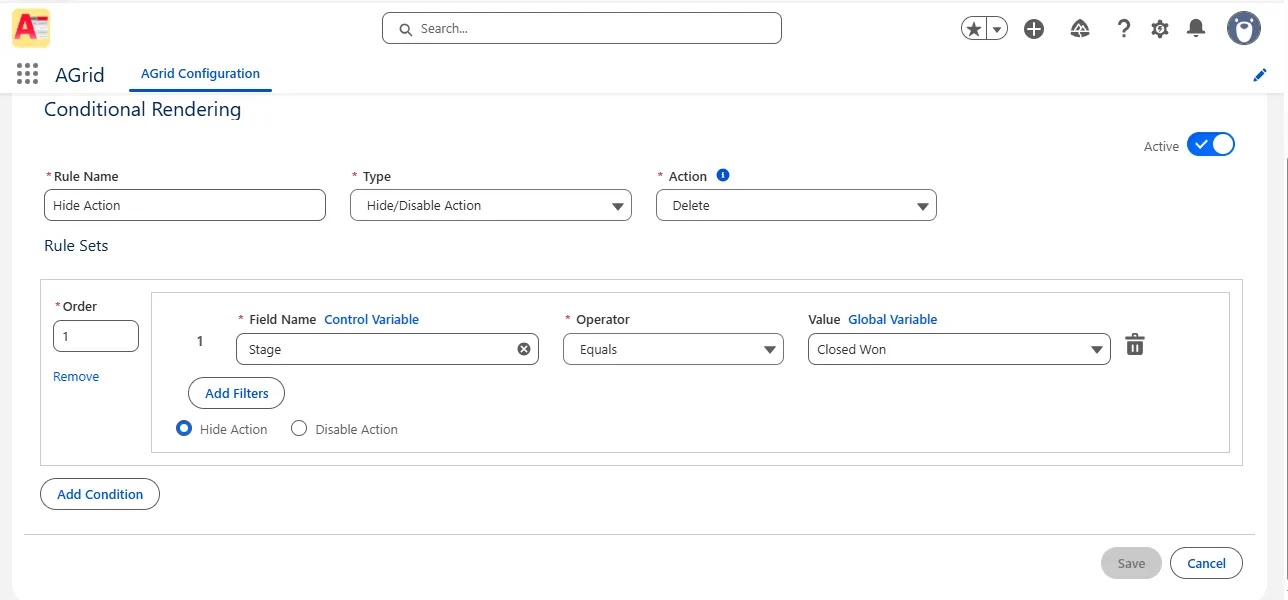

For example:
- Disable Delete when Opportunity Stage equals Closed Won.
- Hide Edit once a record reaches final approval.
This adds rule-based governance directly inside Salesforce list views.
Disable Inline Edit
Inline editing is efficient, but not every record should remain editable indefinitely.
AGrid allows inline editing to be conditionally restricted at:
- Row level
- Column level
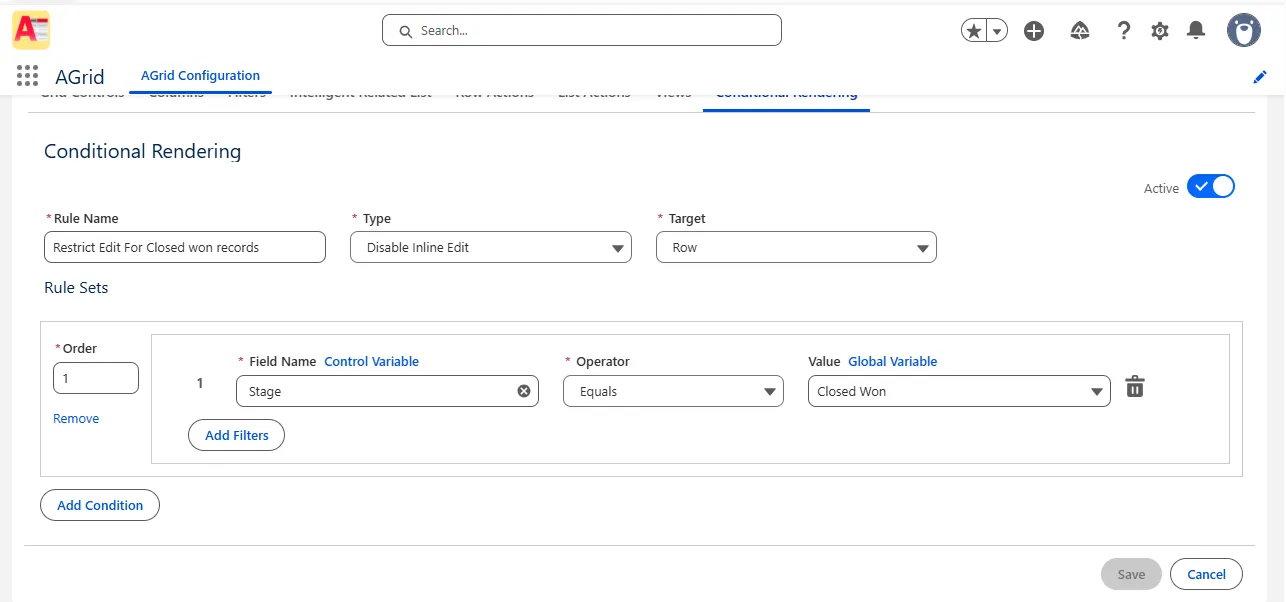

For example:
- Lock financial fields once an Opportunity is finalized.
- Prevent editing of approved records automatically.
This improves data integrity without altering object configuration.
Configure Conditional Formatting
Conditional formatting in AGrid is built around a structured rule model that keeps configuration predictable and scalable. To create a rule, admins:
- Rule Name: Enter a meaningful name for the Conditional Rendering rule.
- Choose the Rule Type (Highlight, Hide/Disable Action or Disable Inline Edit)

- Target Fields: Select which fields or entire rows/columns should be impacted by the conditions.
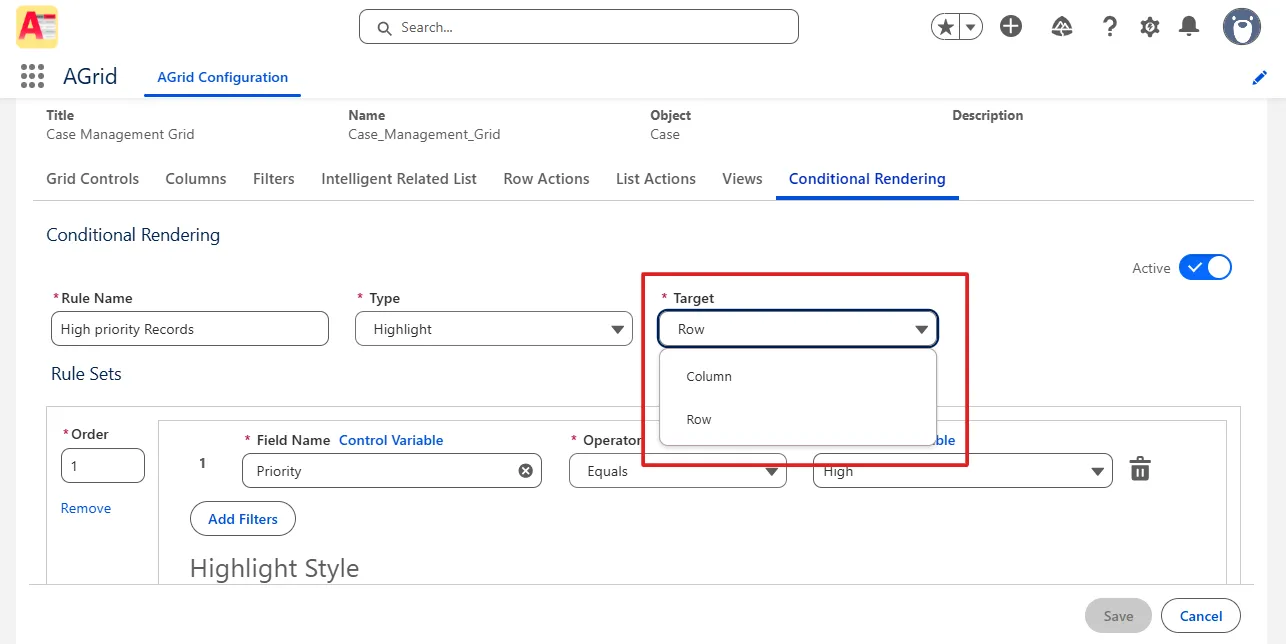
- Set Conditions Easily: Admins can define conditions for applying specific formatting to rows, columns, or individual fields using the Configuration Setup. Key fields include:
- Condition Criteria: Set logical rules for each field (e.g., greater than, equal to, contains).
- Formatting Options: Choose colors, text styles to highlight values.
- Preview and Adjust: Admins can preview visual changes in real time to ensure they meet expectations before finalizing.
- Set Rule Order: Rules are evaluated sequentially. When multiple conditions apply, priority determines the outcome.
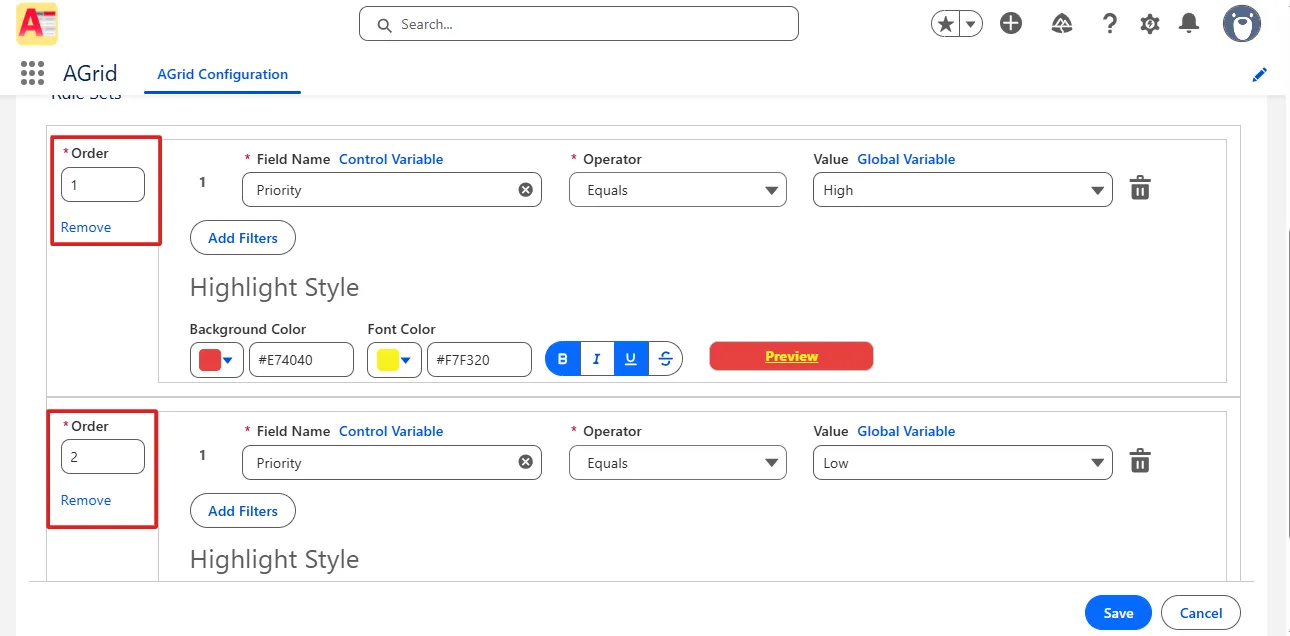
This centralized, no-code configuration allows conditional formatting in Salesforce list views to remain controlled, structured, and easy to maintain.
Note : Highlight: If both Row Highlight and Column Highlight are applied, the Column Highlight takes priority for that column, and the Row Highlight will not apply there.
Conditional Highlighting for End Users
AGrid also allows admins to enable Conditional Highlighting for end users, introducing personalized visibility inside Salesforce list views and related lists.
Admins can enable the “Enable Conditional Highlighting for End User” checkbox in the configuration.

When enabled:
- Users can create their own highlight rules based on their daily priorities.
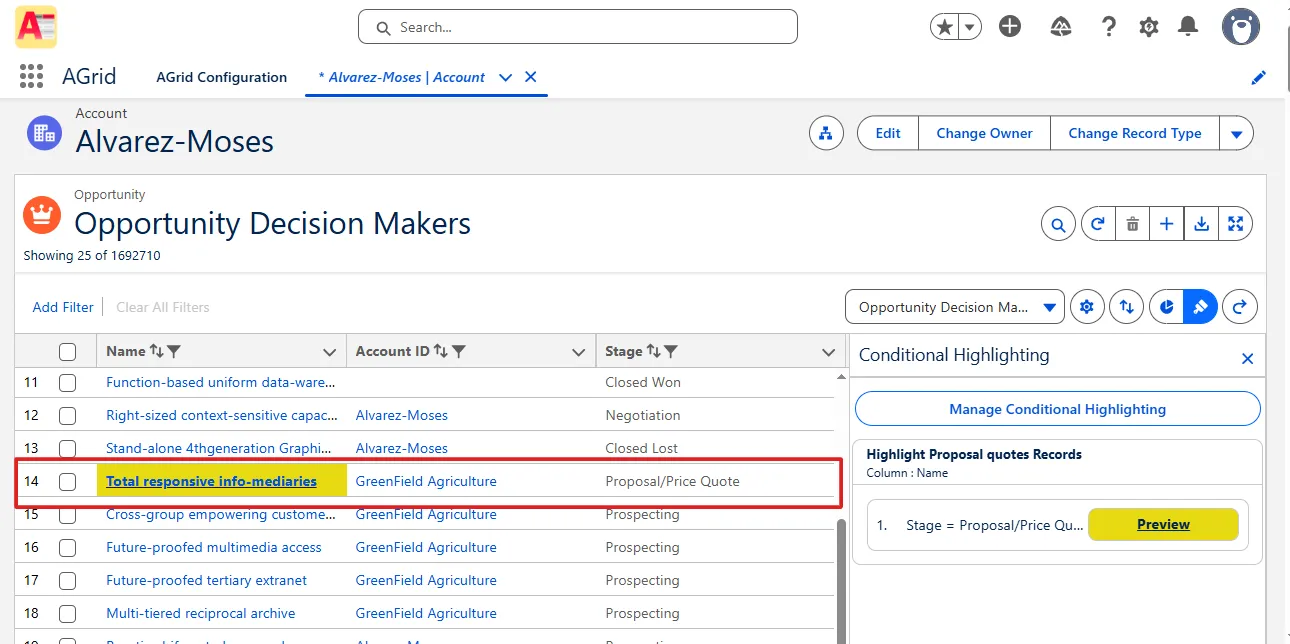
- They can emphasize specific rows or columns relevant to their workload.
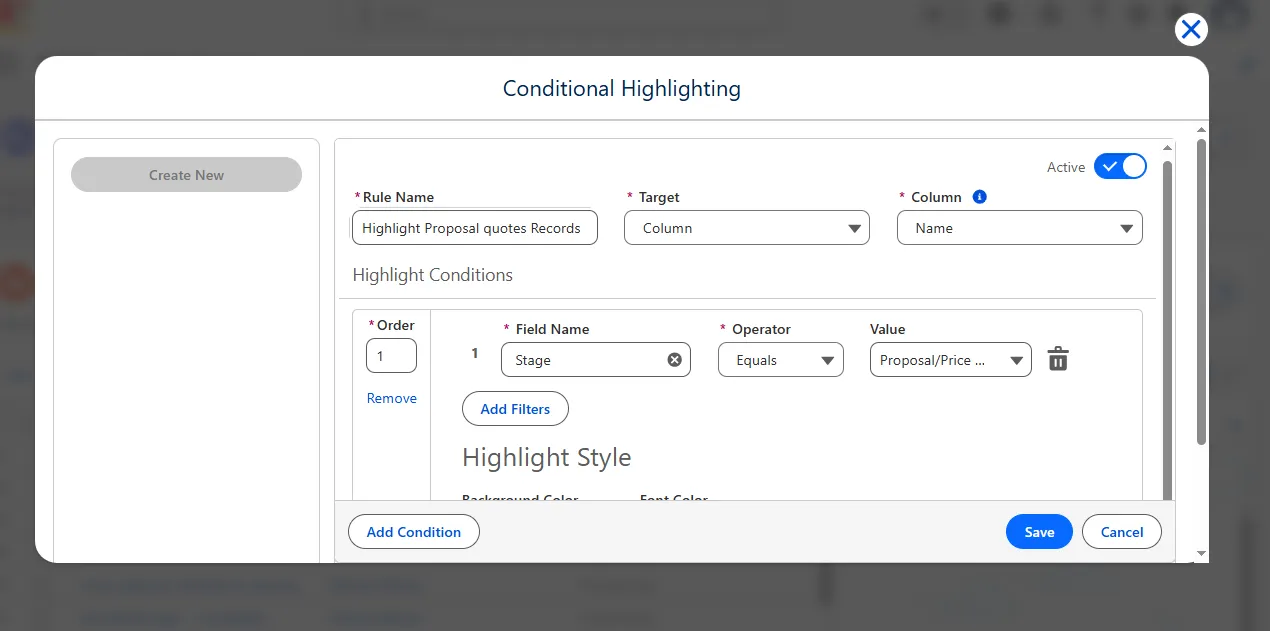
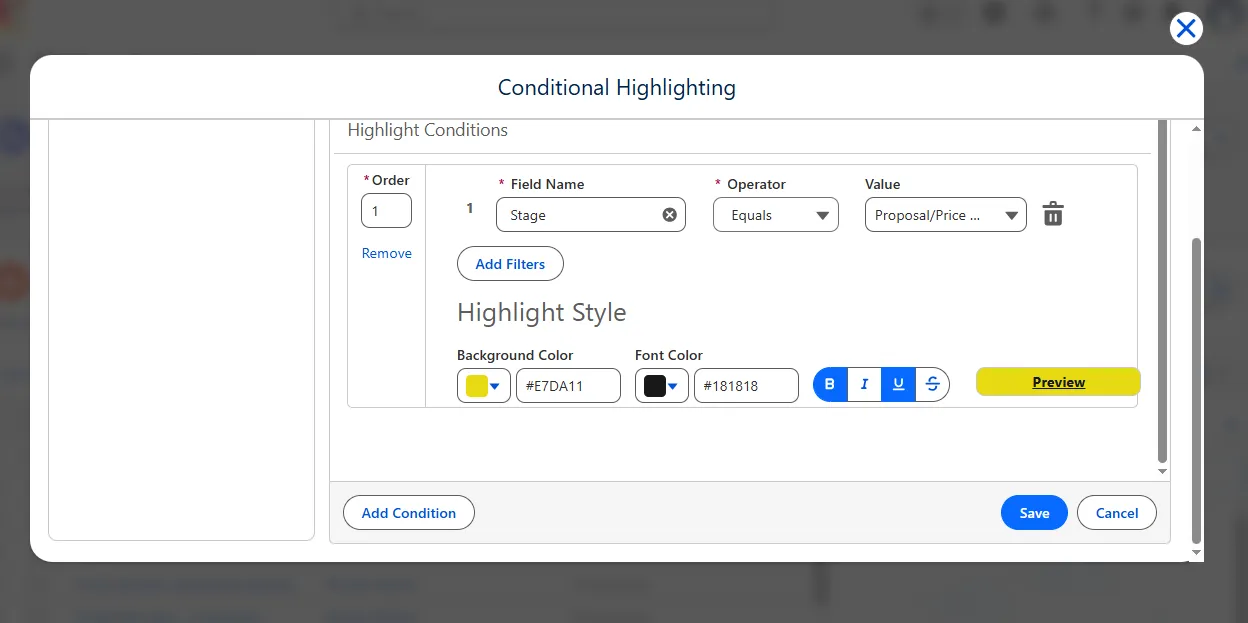
- Admin-defined rules can be temporarily deactivated.
- Default logic can be restored instantly using Reset.

This allows users to create personalized list view highlighting without altering the base configuration.
Admins retain full governance and can override or manage default behavior at any time.
The result is a balanced model: Organizational structure defined by admins. Personalized visibility tailored by users.
This level of user-driven conditional highlighting inside Salesforce list views is not available natively.
More than Conditional Formatting in AGrid
Conditional formatting is only one dimension of what AGrid provides.
Within the same grid environment, users can:
- Adjust columns dynamically
- Apply advanced filters
- Use multi-level sorting
- Configure grid options
- Surface related data through Intelligent Related Lists
- Trigger powerful row actions connected to Flows or Lightning components

Instead of treating Salesforce list views as static tables, AGrid turns them into configurable workspaces designed for operational efficiency.
Conclusion
The demand for conditional formatting in Salesforce list views has been consistent across the community. While Salesforce provides formatting in analytics and record contexts, operational list views often require deeper control.
AGrid extends conditional highlighting directly into Salesforce list views and related lists — enabling row-level emphasis, contextual action control, inline edit governance, and user-level personalization.
If improving Salesforce list view visibility and control is important to your organization, explore AGrid on AppExchange page or request a personalized demo to see it in action.
You can also explore our detailed User Manual for more insights
Want to Highlight What Matters?
More Insights for you









Ready to Transform Your Business with Salesforce & AI?
