

Managed Services for Salesforce: 12 Benefits That Drive Real ROI



Table of Contents


Implementing Salesforce is only the beginning. As business processes change, users join or leave, integrations grow, and Salesforce introduces new capabilities, the org needs ongoing attention.
For many businesses, that creates a challenge. Internal Salesforce teams are often balancing user requests, administration, development, troubleshooting, data quality, releases, integrations, and longer-term improvements at the same time.
Managed services for Salesforce provide ongoing access to Salesforce expertise without treating every requirement as a separate consulting project. Depending on the engagement, the service can cover administration, development, support, optimization, monitoring, release readiness, and strategic guidance.
The value is not simply having someone available to fix problems. A good managed services model helps keep Salesforce aligned with the business as requirements evolve.
Here are 12 practical benefits organizations can gain from Salesforce managed support services.
What Are Managed Services for Salesforce?
Salesforce managed services are an ongoing support model in which an external Salesforce team helps operate, maintain, enhance, and optimize an organization’s Salesforce environment.
Unlike a one-time implementation project with a defined start and end, managed services typically continue month to month or under a longer-term support agreement. The scope can include:
- Salesforce administration and configuration
- User and access management
- Flow and automation maintenance
- Apex and Lightning Web Component development
- Integration support
- Data quality improvements
- Troubleshooting and user support
- Release readiness
- Security reviews
- Backlog management
- Platform optimization
This differs from traditional Salesforce consulting, which is often centered around a specific implementation, migration, integration, or transformation project.
Managed services can work for organizations of different sizes. A smaller business may use them instead of maintaining a full Salesforce team, while a larger enterprise may use managed support to extend its internal Center of Excellence or handle specific workstreams.
Why Businesses Need Managed Services for Salesforce
Salesforce environments rarely remain static. As adoption increases, organizations add fields, objects, Flows, integrations, reports, permission sets, applications, and custom code. Without ongoing governance, these changes can create duplicate automation, unused configuration, inconsistent data, performance issues, and growing technical debt.
Salesforce itself also changes continuously. The platform has three major seasonal releases each year - Spring, Summer, and Winter and some products now receive updates more frequently. Salesforce also provides sandbox previews before production releases so organizations can evaluate upcoming changes.
Keeping up with all of this can become difficult when an internal administrator is already handling daily user requests.
Managed services for ongoing Salesforce administration can provide additional capacity and specialized expertise while allowing internal teams to focus on business priorities.
12 Proven Benefits of Managed Services for Salesforce
1. Access to Salesforce Experts
One of the biggest advantages of a managed services model is access to a broader range of Salesforce skills.
Instead of depending on one administrator to solve every problem, a qualified managed services provider may provide access to administrators, developers, consultants, integration specialists, and architects based on the requirement.
This becomes useful when the work changes from routine administration to something more specialized, such as Apex development, integration troubleshooting, complex automation, or security architecture.
Organizations can access different skills when needed without necessarily hiring a full-time specialist for every role.
2. Reduced Operational Costs
Building a complete internal Salesforce team involves more than salaries. Businesses also need to account for recruiting, onboarding, training, benefits, retention, management, and the challenge of maintaining coverage when employees are unavailable.
Managed services can offer a more predictable operating model because support is usually purchased according to an agreed capacity, scope, or service level.
This does not mean managed services are automatically cheaper in every situation. Organizations with large, continuous Salesforce workloads may benefit from dedicated internal teams.
However, where demand changes month to month, managed services can help businesses pay for the level and mix of Salesforce expertise they actually need.
3. Faster Issue Resolution
Salesforce issues can directly affect sales, service, operations, reporting, and other business processes.
A structured Salesforce managed support model gives users a defined way to raise issues and allows support teams to prioritize incidents based on severity and agreed response times.
Instead of an internal administrator working through an ever-growing backlog alone, tickets can be distributed across a wider team.
Ongoing support also builds familiarity with the org. Over time, the managed services team understands existing automation, integrations, data structures, and business processes, which can make troubleshooting more efficient.
4. Continuous Salesforce Optimization
A Salesforce org can work correctly and still be inefficient. Over time, organizations may accumulate unused fields, outdated reports, overlapping automation, inefficient Apex, old permission structures, or features that users no longer need.
Managed services for Salesforce optimization provide an opportunity to review the environment regularly instead of waiting until something fails.
Optimization activities can include:
- Reviewing automation and customizations
- Identifying technical debt
- Simplifying user experiences
- Reviewing slow or inefficient processes
- Evaluating unused functionality
- Prioritizing improvements
Security can also be reviewed using Salesforce’s native Health Check capability, which compares an org’s security settings against a Salesforce or custom security baseline and identifies potentially risky configurations.
5. Scalability on Demand
Salesforce workloads are rarely consistent throughout the year. An organization may need more support during a major product launch, acquisition, integration project, data migration, business-unit rollout, or Salesforce release.
Managed services give businesses the flexibility to increase the level of support when demand grows and reduce it when the workload becomes more routine, depending on the provider’s engagement model.
This can be particularly useful when an organization needs temporary access to skills that would not justify a permanent hire.
6. Faster Adoption of New Salesforce Features
Salesforce’s major releases introduce new functionality and platform changes three times each year. Some Salesforce products can also receive monthly updates.
Simply receiving new functionality, however, does not mean an organization automatically receives value from it. Someone still needs to:
- Review the release notes
- Identify relevant capabilities
- Test changes in sandbox
- Assess the impact on existing configuration
- Plan deployment
- Communicate changes to users
A managed services team can incorporate release readiness into ongoing administration and identify useful capabilities such as new Flow functionality, platform enhancements, or applicable AI and Agentforce features rather than allowing valuable functionality to remain unused.
7. Improved Data Quality and Governance
Poor data quality affects reports, automation, integrations, analytics, and AI initiatives. Ongoing Salesforce administration can include duplicate management, validation rules, required-field reviews, data cleanup, field standardization, and governance processes.
The goal should not be periodic cleanup alone. Good governance helps prevent poor-quality data from entering Salesforce in the first place.
A managed services provider can work with business teams to establish ownership, validation requirements, naming standards, and processes for maintaining data quality as Salesforce evolves.
8. Better Security and Access Governance
Salesforce security requires ongoing administration, particularly as users change roles and new functionality is introduced.
Salesforce recommends a permission-set-led approach to access management, using profiles primarily for baseline settings and permission sets or permission set groups to grant required access. Salesforce also recommends following least-privilege principles when configuring user access.
Managed Salesforce support can help teams regularly review:
- User access
- Permission sets and permission set groups
- Object and field permissions
- Sharing configuration
- Inactive users
- Integration-user permissions
- Security Health Check findings
Where regulations such as GDPR or HIPAA apply, the Salesforce configuration should form part of the organization’s wider compliance program rather than being treated as compliance by itself.
9. Increased Business Agility
Small Salesforce improvements can sometimes remain in internal backlogs for weeks because larger IT projects receive priority. Managed services provide dedicated capacity for ongoing enhancements such as new fields, reports, dashboards, Flows, page changes, integrations, and user requests.
That can shorten the path between identifying a business requirement and delivering the Salesforce change.
A well-managed backlog also helps distinguish urgent fixes from enhancements and strategic work so teams can prioritize changes according to business value.
10. Proactive System Monitoring
Waiting for users to report every Salesforce problem is a reactive approach. Some areas of an org can be monitored regularly to identify potential issues earlier.
For example, Salesforce provides visibility into API consumption through Setup and tracks API use over rolling time windows. Administrators can also review current data and file storage consumption through the Storage Usage page.
Salesforce also provides monitoring for failed and paused Flow interviews. The Automation app can show failed Flow runs, error details, and debugging information.
A managed service can incorporate checks such as:
- API consumption
- Data and file storage
- Failed Flows
- Integration failures
- Scheduled jobs
- Automation errors
The exact monitoring capability depends on the org, products, integrations, and monitoring tools being used.
11. Strategic Roadmap Support
Salesforce administration should not become a continuous stream of unrelated tickets. A mature managed services engagement should periodically review what the business wants to achieve and how the Salesforce roadmap supports those goals.
Roadmap discussions may cover:
- Upcoming business priorities
- Technical debt
- Automation opportunities
- Integrations
- Licensing and feature utilization
- New Salesforce capabilities
- User experience improvements
- Data and AI readiness
This allows teams to balance immediate support with longer-term platform improvement.
12. Higher Salesforce ROI
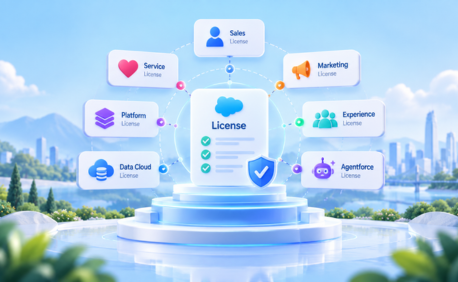
Organizations do not gain value from Salesforce simply because users have licenses. Value comes when the platform supports important processes, users adopt it, data remains trustworthy, automation reduces unnecessary work, and the organization continues improving the system.
The benefits of managed services for Salesforce ultimately come together here: expert support, faster changes, stronger governance, better adoption, and continuous optimization can help organizations use more of the capabilities they are already paying for.
The most useful measure of ROI is therefore not the number of changes completed. It is whether Salesforce is producing measurable improvements in business processes and outcomes.
Managed Services vs. In-House Salesforce Team: Which Is Right for You?
Neither model is automatically better. The right choice depends on workload, complexity, budget, and how strategically important Salesforce is to the organization.
A dedicated internal Salesforce team makes sense when there is enough continuous work to support multiple specialized roles. Managed services can be more suitable when workload fluctuates or the organization needs broader skills than it can efficiently maintain internally.
Many organizations use a hybrid model, with internal Salesforce owners handling business priorities and governance while a managed services partner provides additional delivery and technical capacity.
What to Look for in a Salesforce Managed Service Provider
The quality of the provider matters as much as the managed services model itself. Look for:
- Relevant Salesforce-certified professionals
- Experience across administration, development, integrations, and architecture
- Clearly defined response-time expectations and SLAs
- A transparent approach to capacity and prioritization
- Industry or use-case experience relevant to your organization
- Clear reporting on requests, completed work, risks, and backlog
- Strong documentation and knowledge-transfer practices
- A proactive approach to optimization rather than ticket resolution alone
Also clarify whether you will receive dedicated resources, shared resources, or a combination of both.
The right provider should understand not only how Salesforce works but how your business uses it.
How Softsquare Delivers Salesforce Managed Services
Softsquare’s Salesforce managed services are designed to provide ongoing support beyond implementation. We can work alongside internal Salesforce and business teams to support administration, enhancements, development, integrations, troubleshooting, optimization, release readiness, and technical guidance.
Rather than approaching every Salesforce requirement as a separate project, the managed services model provides continuity. The team can build knowledge of the org over time, manage prioritized requirements, resolve day-to-day issues, and identify opportunities to improve how Salesforce supports the business.
The objective is to help keep the Salesforce environment stable today while continuing to improve it for future requirements.
Conclusion
Salesforce needs ongoing attention to continue delivering value after implementation. Managed services provide organizations with access to Salesforce expertise, additional capacity, ongoing optimization, stronger governance, proactive support, and a more structured approach to platform improvements.
The right model depends on the organization. Some businesses need a fully internal Salesforce team, others benefit from outsourced support, and many find that a hybrid approach provides the best balance.
What matters most is having a clear ownership model and continuously aligning Salesforce with business priorities rather than allowing the platform to evolve without active governance.
Ready to Transform with AI?
Frequently Asked Questions
Managed services for Salesforce provide ongoing administration, support, development, optimization, and technical assistance for an organization’s Salesforce environment, usually through a recurring service engagement.
Pricing varies based on the number of hours or resources required, the complexity of the Salesforce environment, required expertise, service levels, and whether support uses dedicated or shared resources.
Depending on the provider and plan, services can include administration, user support, configuration, Flow development, Apex or LWC development, integrations, troubleshooting, data quality, security reviews, release readiness, and optimization.
Implementation projects usually focus on delivering a defined solution within a specific project timeline. Managed services focus on the ongoing operation, support, maintenance, and enhancement of Salesforce after or between major projects.
Yes. Managed services can be useful for smaller businesses that need reliable Salesforce administration and technical expertise but do not have enough ongoing work to justify building a complete in-house Salesforce team.
Managed services can improve ROI by helping organizations increase adoption, reduce technical debt, resolve issues faster, improve data quality, use relevant Salesforce features, and continuously align the platform with business requirements.
A Salesforce managed service provider is a company that provides ongoing Salesforce administration, support, development, optimization, and related services under a recurring engagement rather than only delivering one-time implementation projects.
More Insights for you



.png)







Ready to Transform Your Business with Salesforce & AI?
