

Transforming Workplace Safety with Vision AI and Compliance Monitoring


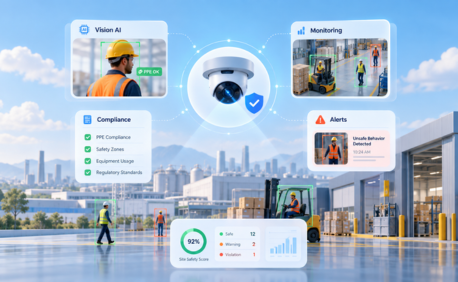
Table of Contents


Workplace safety depends on people, processes, and timely action. But as operations expand across facilities, shifts, and job sites, maintaining consistent oversight becomes harder. Manual checks help, but they are periodic by nature and often miss real-time risks.
That is where Vision AI for workplace safety becomes valuable. By analyzing live video feeds from existing cameras, organizations can strengthen workplace safety compliance monitoring, detect unsafe acts earlier, and respond faster with more consistency.
Key takeaways
- Vision AI supports real-time workplace safety monitoring where risks are visually observable
- The most effective deployments reduce alert fatigue with thresholds, severity levels, and clear workflows
- Salesforce can convert detections into actions, investigations, and audit-ready reporting
The Pain Point: Workplace Safety Compliance Monitoring Is Still Largely Reactive
Most organizations already have safety policies, PPE rules, and compliance standards in place. The real challenge is not defining safety expectations. The challenge is enforcing them consistently across locations, teams, and shifts.
In many environments, workplace safety compliance monitoring still depends heavily on manual audits, supervisor observation, and post-incident reviews. That makes it difficult to catch risks early and respond before a minor issue becomes a serious event.
Common issues include:
- Safety violations going unnoticed in real time
- PPE non-compliance across shifts and locations
- Unsafe conditions detected only after incidents
- Heavy reliance on manual patrols and audits
- Limited visual evidence during investigations
Why this matters: even one missed incident can lead to injuries, downtime, penalties, and reputational damage.
What Is Vision AI for Workplace Safety?
Vision AI for workplace safety is a vision ai solution that uses computer vision models to analyze live or recorded video feeds from cameras installed across facilities. Instead of passively storing footage, the system actively identifies observable risks and compliance gaps.
For organizations looking to strengthen workplace safety compliance, this means cameras can do more than record events. They can help detect unsafe behavior, flag hazards, and support faster action using visual evidence.
Vision AI actively:
- Detects visually observable risks such as PPE gaps, zone breaches, and obstructions
- Monitors compliance with safety rules
- Flags events in near real time
- Stores visual evidence for audits and reviews
This transforms cameras from passive observers into active safety signals.
How Vision AI Workplace Safety Monitoring Works
Vision AI workplace safety monitoring connects camera feeds, applies computer vision models, and turns detections into usable safety signals. It helps organizations move from delayed reporting to continuous visibility across the areas that matter most.
For teams investing in workplace safety monitoring with computer vision, the value comes from combining real-time detection with practical workflows, so safety teams can review, respond, and improve over time.
Video input from existing cameras
Vision AI connects to CCTV or IP cameras already installed across workplaces such as factories, warehouses, airports, construction sites, and offices. This makes vision ai solutions initiatives easier to adopt because organizations can often build on current infrastructure instead of replacing it.
It also supports stronger workplace safety and compliance by extending visibility across shifts and locations where constant manual oversight is difficult.
Real-time visual analysis
AI models analyze video to recognize:
- People, equipment, and defined zones
- Safety gear such as helmets, vests, and masks based on PPE policy
- Hazardous conditions such as spills, obstructions, and visible smoke or fire indicators
- Restricted-area access or zone breaches
Detection and classification
Each event is:
- Detected
- Categorized such as PPE violation, unsafe condition, or restricted access
- Time-stamped with visual context
Alerts and evidence
When a risk is detected:
- Alerts can be triggered based on severity
- Evidence is stored for review
- Safety teams can act immediately
Why this matters: risks are addressed earlier, before they escalate into incidents.
Why Vision AI Is Well-Suited for Workplace Safety & Compliance Monitoring
Safety is one of the strongest use cases for Vision AI because many risks are visually observable, recurring, and time-sensitive. Unlike manual oversight, workplace safety ai can support workplace safety compliance monitoring continuously across covered areas and operating hours.
This makes Vision AI especially valuable in environments where consistency matters, audits are frequent, and safety teams need better visibility without adding constant manual effort.
Practical benefits include:
- 24×7 automated monitoring where camera coverage exists
- Faster detection of unsafe conditions
- Reduced dependency on manual patrols for routine checks
- Objective audit trails for investigations and compliance reviews
- Better accountability across teams and shifts
Workplace Safety and Compliance Use Cases
The value of Vision AI for workplace safety becomes clearer when applied to real operational scenarios. From PPE monitoring to restricted zone detection, these use cases help organizations strengthen both prevention and response.
For teams focused on AI workplace safety monitoring, these use cases also create a more evidence-based approach to audits, coaching, and corrective action.
PPE compliance monitoring
Detect whether workers are wearing required gear such as helmets, vests, masks, or gloves based on policy.
Why this matters: improves adherence without requiring constant supervision.
Unsafe condition detection
Identify environmental hazards such as:
- Wet or slippery floors
- Obstructions in walkways
- Unsafe equipment placement
Why this matters: prevents accidents caused by avoidable hazards.
Restricted area and intrusion detection
Monitor access to:
- Restricted zones
- High-risk operational areas
Why this matters: reduces unauthorized access and liability exposure.
Zone breach and proximity risk detection
Detect rule-based scenarios such as:
- Crossing a marked barrier
- Entering an exclusion zone around active machinery
- Presence in a restricted forklift or pedestrian zone where rules are defined
Why this matters: enables proactive intervention and coaching.
Note: feasibility depends on camera angles, site rules, and privacy constraints.
Emergency indicator detection
Flag visual indicators such as:
- Smoke or fire signals where camera quality supports detection
- Unusual crowd movement patterns in defined areas
Why this matters: supports faster escalation and response.
Workplace Safety and Compliance Audit Support
Beyond real-time alerts, Vision AI helps organizations improve compliance programs by creating structured, time-stamped evidence. That makes workplace safety compliance more consistent and less dependent on anecdotal reporting.
For EHS teams, this means audits, reviews, and investigations can be supported by actual visual records instead of incomplete manual documentation alone.
Beyond real-time intervention, Vision AI strengthens compliance by:
- Creating time-stamped visual records
- Supporting investigations with objective evidence
- Tracking compliance trends over time
- Reducing manual documentation effort
Why this matters: audits become evidence-based rather than anecdotal.
Common Challenges in Vision AI Workplace Safety Monitoring
Like any operational technology, Vision AI workplace safety monitoring works best when it is planned responsibly. Strong results depend not only on the model, but also on camera coverage, alert tuning, review workflows, and governance.
Organizations that approach workplace safety ai very thoughtfully are more likely to reduce false alerts, gain user trust, and scale successfully across sites.
Treating Vision AI as “plug and forget”: Environments change. Lighting, layouts, uniforms, and camera angles shift over time. Models and rules need periodic review.
Poor camera coverage: Blind spots reduce effectiveness. Start by validating coverage in high-risk zones.
Over-alerting or alarm fatigue: Reduce noise using:
- Severity tiers
- Confidence thresholds
- Cooldown windows
- Batching for low-risk events
- Shift-based routing and escalation rules
No human oversight: Critical decisions should include human judgment and review steps for high-severity alerts.
Checklist for Vision AI Workplace Safety Monitoring
A practical rollout approach:
- Identify the top safety risks and highest-risk zones
- Define what counts as a violation, including rules, thresholds, and severity
- Validate camera readiness, including coverage, angles, lighting, and retention
- Establish privacy and governance guidelines
- Design the human-in-the-loop workflow for review, coaching, and escalation
- Configure alert tuning such as thresholds, cooldowns, and batching
- Run a pilot, measure outcomes, then expand to more zones and use cases
- Maintain a review cadence as environments change
How Salesforce Turns Vision AI Alerts Into Action
Vision AI is most valuable when detections trigger consistent response workflows, not just notifications.
A practical Salesforce pattern looks like this:
Detect → Create record → Route → Resolve → Report
- Detect: Vision AI produces an event with type, severity, time, zone, and evidence snapshots
- Create: Salesforce stores the event as a safety observation or incident record
- Route: Assign to the right team based on site, shift, zone, or risk category
- Resolve: Trigger tasks, checklists, acknowledgment steps, and escalations
- Report: Dashboards track repeat hotspots, PPE compliance, response times, and recurring violations
Salesforce becomes the system of action by providing traceability, accountability, and reporting while keeping people in control of critical decisions.
Conclusion
Using Vision AI for workplace safety helps organizations shift from reactive incident response to proactive risk prevention. By detecting unsafe conditions earlier, improving workplace safety and compliance create audit-ready evidence, Vision AI strengthens both safety programs and operational accountability.
For safety-critical environments, Vision AI is not about replacing people. It is about giving teams better visibility, faster response, and a stronger foundation for protecting workers at scale.
Ready to Transform with AI?
More Insights for you






Ready to Transform Your Business with Salesforce & AI?
