

10 Salesforce Marketing Cloud Personalization Use Cases Across Industries


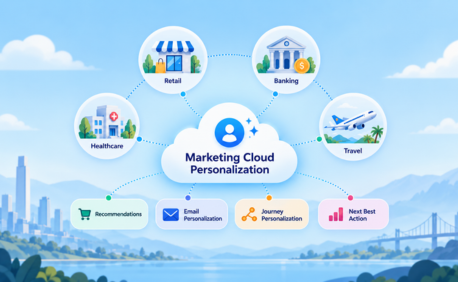
Table of Contents


Customers move across websites, email, mobile apps, service channels, and other touchpoints. When those experiences do not share context, interactions can quickly feel generic and disconnected.
Salesforce Marketing Cloud Personalization helps businesses use real-time behavior and profile data to deliver more relevant content, offers, recommendations, and next actions across customer journeys.
This article explores 10 marketing cloud personalization use cases across industries, followed by key benefits and implementation best practices.
What Is Salesforce Marketing Cloud Personalization?
Salesforce Marketing Cloud Personalization is Salesforce's real-time personalization platform, formerly known as Interaction Studio and originally based on Evergage.
It combines behavioral signals such as views, searches, clicks, and purchases with customer profile data to decide which content, product, offer, or experience is most relevant in the moment.
A key part of this is Real-Time Interaction Management (RTIM). In simple terms, RTIM analyzes what a customer is doing right now, combines it with what is already known about them, and helps determine the most relevant experience or next action instantly.
Marketing Cloud Personalization is different from Salesforce Personalization, Salesforce's next-generation personalization solution powered by Data 360 and Agentforce. Both solutions support personalization, but their architectures and implementation approaches differ.
Core Salesforce Marketing Cloud Personalization features include:
- Behavioral tracking across web and mobile experiences.
- Identity and profile unification across customer interactions.
- Real-time segmentation and decisioning based on behavior and attributes.
- Einstein-powered product and content recommendations.
- Personalized experiences across web, email, mobile, and connected channels.
- A/B testing and experience optimization.
- Integration with Marketing Cloud, Data 360 (formerly Data Cloud), CRM, commerce, and other data sources.
Why Personalization Matters for Businesses Today
Customers expect relevant experiences across every channel, but their data is often spread across disconnected systems.
Salesforce brings together unified customer data, real-time behavior, AI, and automation to help businesses understand customer intent and respond with the right content or offer.
Marketing Cloud Personalization supports this with real-time decisioning and Einstein-powered recommendations, helping improve engagement, conversion, retention, and loyalty.
10 Salesforce Marketing Cloud Personalization Use Cases Across Industries
Salesforce Marketing Cloud Personalization can support different customer journeys across industries by using customer data, behavior, and real-time interactions to deliver more relevant experiences.
1. Retail & eCommerce
Retailers can personalize product recommendations, offers, emails, and landing pages based on browsing history, purchase behavior, and customer interests.
Example: An online retailer can recommend products based on recently viewed items and continue those recommendations through follow-up emails if the shopper leaves without purchasing.
2. Financial Services & Banking
Banks and financial institutions can use unified customer data to deliver relevant product recommendations, educational content, and next-best offers.
Example: A bank can identify a customer researching home loans and display mortgage-related content or offers across its website and email communications.
3. Healthcare
Healthcare organizations can use permitted profile and engagement data to personalize outreach, educational content, and relevant service information.
Example: A healthcare provider can personalize approved wellness content and follow-up communications based on a patient's preferences, previous interactions, and engagement journey.
4. Hospitality & Travel
Travel and hospitality companies can personalize booking experiences and offers based on stay history, travel preferences, loyalty status, and customer interactions.
Example: A hotel can recognize a returning loyalty member and present preferred room types, relevant upgrades, or destination offers during the booking process.
5. Media, Sports & Entertainment
Media and entertainment organizations can personalize content, fan communications, merchandise recommendations, and post-event experiences using viewing, ticketing, and purchase behavior.
Example: A sports organization can recommend team merchandise after a fan attends a match or interacts with related content online.
6. Education
Educational institutions can personalize student portals, campus communications, events, and recommendations based on interests, courses, engagement, and location.
Example: A university can highlight relevant clubs, workshops, and campus events based on a student’s course selections and previous interests.
7. Nonprofit & Fundraising
Nonprofits can personalize fundraising messages, website content, and email communications using donor history, interests, and engagement.
Example: A nonprofit can show different donation campaigns to supporters based on the causes they previously supported or content they engaged with.
8. Utilities & Energy
Utilities and energy providers can personalize website content, recommendations, and retention communications based on customer behavior and account information.
Example: An energy provider can recommend energy-saving programs or relevant service plans based on a customer’s usage patterns and website activity.
9. Technology & SaaS
Technology and SaaS companies can personalize onboarding, feature recommendations, lifecycle communications, and upgrade opportunities based on product usage and customer behavior.
Example: A SaaS company can identify features a new user has not explored and display relevant onboarding tips, tutorials, or reminders based on their activity.
10. Manufacturing
Manufacturers can personalize digital experiences for engineers, buyers, distributors, and OEM partners based on account information, industry, engagement, and product interest.
Example: A manufacturer can identify when a high-value account repeatedly visits technical specification or pricing pages, personalize related content, and alert the sales team for timely follow-up.
Key Benefits of Salesforce Marketing Cloud Personalization Across Industries
Across industries, Marketing cloud personalization can create value across a few common business areas:
- Higher conversion through more relevant content, products, and offers.
- Higher order value or expansion through relevant cross-sell recommendations.
- Better retention and loyalty through consistent cross-channel experiences.
- Less manual campaign work through automation and AI-driven recommendations.
- Faster response to customer behavior in real time.
- Better alignment between marketing, sales, service, and commerce teams.
- Stronger testing and optimization of personalized experiences.
The strongest programs connect each use case to a clear metric such as conversion, onboarding, retention, or qualified engagement.
Best Practices for Implementing Salesforce Marketing Cloud Personalization
A focused marketing cloud personalization implementation helps businesses scale beyond isolated campaigns.
1. Align Teams and Goals: Agree on objectives, ownership, governance, and success metrics before implementation.
2. Map Personas and Journeys: Identify the customer touchpoints where personalization can meaningfully improve the experience.
3. Prepare Content and Catalogs: Tag products, offers, content, and metadata so there are relevant options to personalize.
4. Connect Customer Data Responsibly: Connect CRM, commerce, engagement, and Data 360 data where useful, with clear identity, consent, and privacy controls.
5. Start with High-Impact Use Cases: Begin with one or two measurable use cases, prove value, and then scale.
6. Test and Optimize: Use A/B testing and business outcomes to continuously improve personalized experiences.
7. Establish Governance: Define how AI, sensitive data, new use cases, measurement, and ongoing optimization will be managed.
How Softsquare Helps Businesses Implement Salesforce Marketing Cloud Personalization
Softsquare combines Salesforce consulting expertise with hands-on product engineering experience, helping businesses turn personalization strategies into practical, scalable Salesforce solutions.
As a Salesforce Summit Partner and PDO/ISV, Softsquare brings experience across Marketing Cloud, Data 360, integrations, automation, AI, and Salesforce architecture.
Our approach focuses on:
- Identifying personalization use cases tied to measurable business outcomes.
- Connecting Salesforce and external data to build reliable customer profiles.
- Designing real-time segments, recommendations, journeys, and personalized experiences.
- Integrating Marketing Cloud Personalization with Data 360, Marketing Cloud Engagement, and other Salesforce solutions.
- Testing and continuously improving personalization based on customer behavior and performance.
Rather than treating personalization as a standalone marketing tool, Softsquare helps organizations build it into their broader Salesforce architecture so it can scale across customers, channels, and business teams.
Conclusion
Customers expect businesses to recognize their context and make each interaction relevant, regardless of channel.
Salesforce Marketing Cloud Personalization uses real-time behavioral signals, customer data, rules, and AI to determine the next-best experience across industries.
Start with a measurable use case, connect the required data responsibly, and continuously test the result. Once the model works, expand personalization across additional journeys and channels.
Softsquare can help evaluate the right Salesforce personalization architecture and turn priority use cases into an implementation plan.
Ready to Transform with AI?
Frequently Asked Questions
It helps businesses deliver real-time personalized experiences using customer behavior, profile data, business rules, and AI.
Marketing Cloud Personalization is the established Interaction Studio-based product, while Salesforce Personalization is the newer Data 360-native solution.
Industries such as retail, financial services, healthcare, travel, SaaS, education, utilities, and manufacturing can benefit from personalized customer experiences.
It can use browsing behavior, clicks, searches, purchases, profile data, engagement history, catalogs, and connected customer data.
Marketing Cloud Personalization can use profile and audience data from Data 360, while Einstein uses behavioral and catalog data to help deliver relevant product and content recommendations.
Yes. Marketing cloud personalization can support B2B experiences based on account, industry, role, product interest, and engagement behavior.
Examples include product recommendations in retail, personalized banking offers, adaptive SaaS onboarding, and account-based content for manufacturers.






Ready to Transform Your Business with Salesforce & AI?
