

Transforming Field Service Operations with Field Service AI Agent


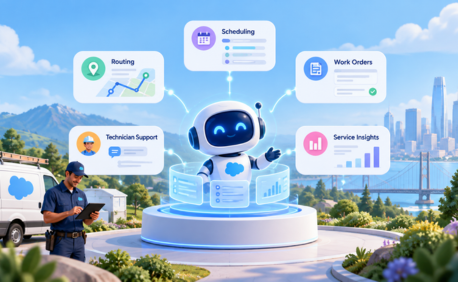
Table of Contents


Field service work has never been simple, but today, it is more unpredictable than ever. Operations leaders and dispatch managers are facing an unprecedented convergence of challenges. Schedules change continuously throughout the day. Traffic delays pile up, and customers expect accurate ETAs. Meanwhile, highly skilled technicians lose valuable time driving instead of fixing problems.
Despite these escalating complexities, most service teams are still holding everything together with manual coordination. Dispatchers are forced to play an endless game of scheduling Tetris, reacting to fires rather than optimizing the board.
That is where a Field Service AI Agent makes a real difference. This is not about replacing your workforce with automation for its own sake. It is about introducing highly capable digital labor that supports dispatchers and technicians, optimizes schedules and routes in real time, and keeps systems like Salesforce continuously updated.
The Strategic Shift: Solving Coordination, Not Just Skill
When assessing service delivery failures—whether it is a missed SLA, a frustrated customer, or a blown budget—leaders often look for a single, catastrophic root cause. However, field service issues rarely come from one big failure; they come from many small ones:
- Routes are planned once in the morning and never revisited.
- Last-minute cancellations disrupt the entire day.
- Technicians arrive on site without full job context.
- Notes and reports are completed and submitted hours later.
- Managers react instead of planning ahead.
These aren't skill problems; their coordination problems.
Adding more rules, building more complex dashboards, or introducing extra manual checks will only slow your teams down further. That is why more enterprise organizations are exploring AI agents for field service instead of adding more rules, dashboards, or manual checks.
What Exactly Is a Field Service AI Agent?
It is critical to separate the reality of Agentic AI from market hype. As highlighted in Salesforce's breakdown of the new wave of AI agents, these systems are not here to replace human service—they are here to elevate it. A Field Service AI Agent is a custom-built AI system designed to support field operations.
It is not a chatbot, and it is not a static automation. It is an agentic system designed to keep work moving—with control. A true Field Service AI Agent operates natively within your ecosystem by:
- Understanding jobs, assets, locations, skills, and SLAs.
- Communicating through text and voice.
- Optimize schedules and routes dynamically.
- Guiding technicians' step by step on site.
- Updating Salesforce and other systems automatically.
- Escalating decisions to humans when needed.
The Engine: Context Awareness and Decision Support
For an AI Agent to be trusted by dispatchers, it must be contextually aware. The agent pulls real-time context from:
- Salesforce work orders, cases, and assets.
- Technician availability and live location.
- Traffic conditions and routing constraints.
- Service history and knowledge bases.
This allows it to react to what's happening now, not what was planned for hours earlier. Using that context, the agent evaluates job priority and urgency, skill and proximity match, travel time and route efficiency, and compliance and safety rules. From there, it recommends or takes the next best action.
(Note: For development teams looking to build these capabilities natively, tools like Agentforce Vibes allow for rapid, prompt-based creation of agentic workflows while maintaining enterprise governance.
Core Capabilities Driving Operational ROI
When a Field Service AI Agent works alongside service teams and mobile workers to handle the decisions and follow-ups that slow everyone down, the results are immediate.
1. Smarter Scheduling, Dispatch, and Route Optimization
Static routing is a drain on profitability. As noted in the Salesforce guide to optimization in the Agentforce era, true optimization requires intelligent, dynamic recalculation. Instead of static routes, AI agents can recalculate routes based on live traffic.
They adjust paths after cancellations or urgent jobs, reduce unnecessary driving and backtracking, and improve on-time arrival rates. This results in lower fuel costs, fewer delays, and happier technicians.
2. Multimodal Interaction: The Power of Voice and Text
Fieldwork doesn't happen at a desk; that's why multimodal AI matters.
- Text to Voice: The agent can speak about route updates, reminders, safety steps, or next actions while technicians are driving or working hands-free.
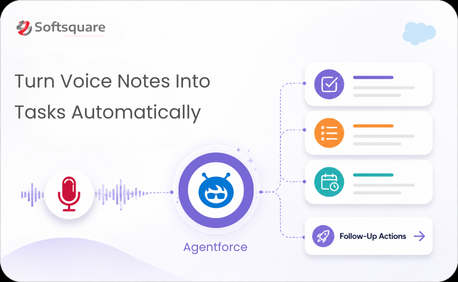
- Voice to Text: Technicians describe in their native language what they're seeing on site, and the agent converts that into structured notes, updates, or checklists.
This reduces screen time, improves data quality, and keeps technicians focused on the job. Softsquare specializes in deploying these exact types of Field Service AI Voice Agents to streamline these workflows.
3. Breaking Down Barriers with Native Language Support
Many field teams are multilingual, and in real-world operations, language friction can slow everything down. A Field Service AI Agent can support technicians in their native language, while still keeping Salesforce records standardized. The business value is clear: fewer misunderstandings, faster execution, and smoother adoption across regions.
4. Step-by-Step Guided Processes on Site
On the job, technicians don't just need answers; they need to clear next steps. A Field Service AI Agent can provide step-by-step guided instructions and adaptive guidance based on what the technician has already tried. This leads to fewer mistakes, faster fixes, and better first-time resolution.
5. Automated Job Summaries and Perfect Data Hygiene
After the job, voice notes become structured in summaries, missing fields are flagged automatically, and notes captured in native languages are standardized automatically. This ensures Salesforce records stay complete and accurate.
6. Proactive Maintenance Planning
AI agents accelerate the transition to proactive service. They can spot early warning signs, suggest preventative visits, and group jobs efficiently by route and location.
Getting Started: Your Digital Transformation Blueprint
A good starting point is asking:
- Where do technicians lose the most time driving?
- How often do schedules fall apart during the day?
- Which updates could be automated safely?
- Where would voice or native language support help most?
Those answers usually reveal the best first AI agent to use case.
Conclusion
A Field Service AI Agent helps teams handle the hardest parts of field operations: scheduling changes, route optimization, technician support, communication, and reporting. When designed with multimodal interaction, native language support, step-by-step guidance, and human oversight, AI agents turn field service from constant firefighting into calmer, more predictable execution. And that's exactly what modern service teams need.
Ready to Transform Your Field Operations?
Transitioning from manual scheduling to Agentic AI doesn't have to be a multi-year IT headache. With the right strategic partner, you can deploy intelligent, native Salesforce solutions that deliver measurable ROI in weeks, not months.
At Softsquare, we specialize in helping enterprise service teams build, implement, and scale Agentforce and Field Service AI solutions tailored to your unique operational bottlenecks.
Take the next step in your digital transformation:
- 🚀 Book a Free Field Service AI Readiness Assessment to identify your highest-ROI use cases.
- 🤖 Explore Our AI Solutions to see how our custom agents handle dynamic dispatch and voice-to-text reporting.
- 📞 Contact Our Salesforce Experts to discuss a pilot implementation for your regional teams.
Stop reacting to the schedule and start optimizing it. Let Softsquare help you build the future of your field operations today.
Ready to Transform with AI?
Frequently Asked Questions
Field service analytics turns operational data into insights that help teams understand technician productivity, service quality, delays, SLA performance, and improvement opportunities.
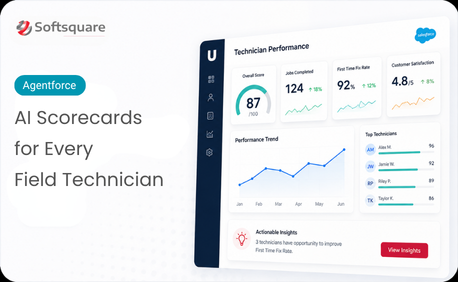
Agentforce can help consolidate relevant Salesforce data, identify patterns, and present technician performance information as readable scorecards and insights.
Work orders, service appointments, cases, assets, activity logs, resolution times, re-open rates, SLA signals, and customer feedback can all contribute.
It is a consolidated view that helps managers understand key technician metrics, trends, risks, and coaching opportunities without reviewing disconnected reports.
Yes. By reviewing service data across jobs and time periods, the solution can highlight recurring delays and other operational patterns that may require attention.
Yes. Consistent performance signals across productivity, quality, SLA results, and customer feedback can help managers recognize strong performers.
Managers can use evidence such as repeat issues, re-open rates, resolution trends, and service quality signals to make coaching discussions more specific.
More Insights for you









Ready to Transform Your Business with Salesforce & AI?
